Indoor Navigation for Malls: How Digital Wayfinding Improves Visitor Experience and Tenant Discovery
Shopping malls are designed to bring dozens or even hundreds of destinations into a single venue. But as malls grow larger, visitors often face a simple problem: finding where they need to go.
A visitor looking for a specific store, restaurant, ATM, washroom, play area, or service desk can easily become frustrated if navigation is unclear. Staff members spend valuable time answering repetitive directional questions, while tenants may lose visibility simply because shoppers cannot find them.
This is where indoor navigation for malls becomes valuable. Modern digital wayfinding systems help visitors search destinations, receive step-by-step directions, explore amenities, and discover new stores through interactive kiosks, mobile devices, and digital directories.
For mall operators, indoor navigation is not just a map. It is a visitor experience tool, an operational efficiency layer, and a platform for improving tenant visibility.
Why Traditional Mall Directories Are No Longer Enough
Most malls still rely heavily on static directories, printed maps, or wall-mounted signage.
While these tools provide basic guidance, they often create challenges:
- Visitors must manually interpret the map.
- Multi-floor routes can be confusing.
- Directory information becomes outdated.
- New stores may be difficult to discover.
- Accessibility routes are not always obvious.
- Staff receive repeated requests for directions.
In busy malls, even a small amount of visitor confusion can affect the overall experience.
Modern shoppers are accustomed to digital navigation in everyday life. They expect the same convenience inside large venues.
What Is Indoor Navigation for Malls?
Indoor navigation is a digital wayfinding system that allows visitors to search for destinations and receive route guidance within a building.
A complete mall wayfinding experience may include:
- Interactive kiosks
- Digital directories
- Mobile web navigation
- QR code route handoff
- Multi-floor routing
- Amenity search
- Accessibility-friendly routes
- Store and tenant discovery
Instead of asking a security guard where a store is located, visitors can search for the destination and immediately receive directions.
Common Destinations Visitors Search For
| Retail & Dining | Amenities & Services |
|---|---|
| Clothing stores | Washrooms |
| Restaurants | Prayer rooms |
| Coffee shops | ATMs |
| Electronics stores | Customer service desks |
| Beauty stores | Parking access points |
| Supermarkets | Elevators and escalators |
| Entertainment zones | Emergency exits |
The larger the venue, the greater the benefit of searchable navigation.
How Interactive Kiosks Improve the Mall Experience
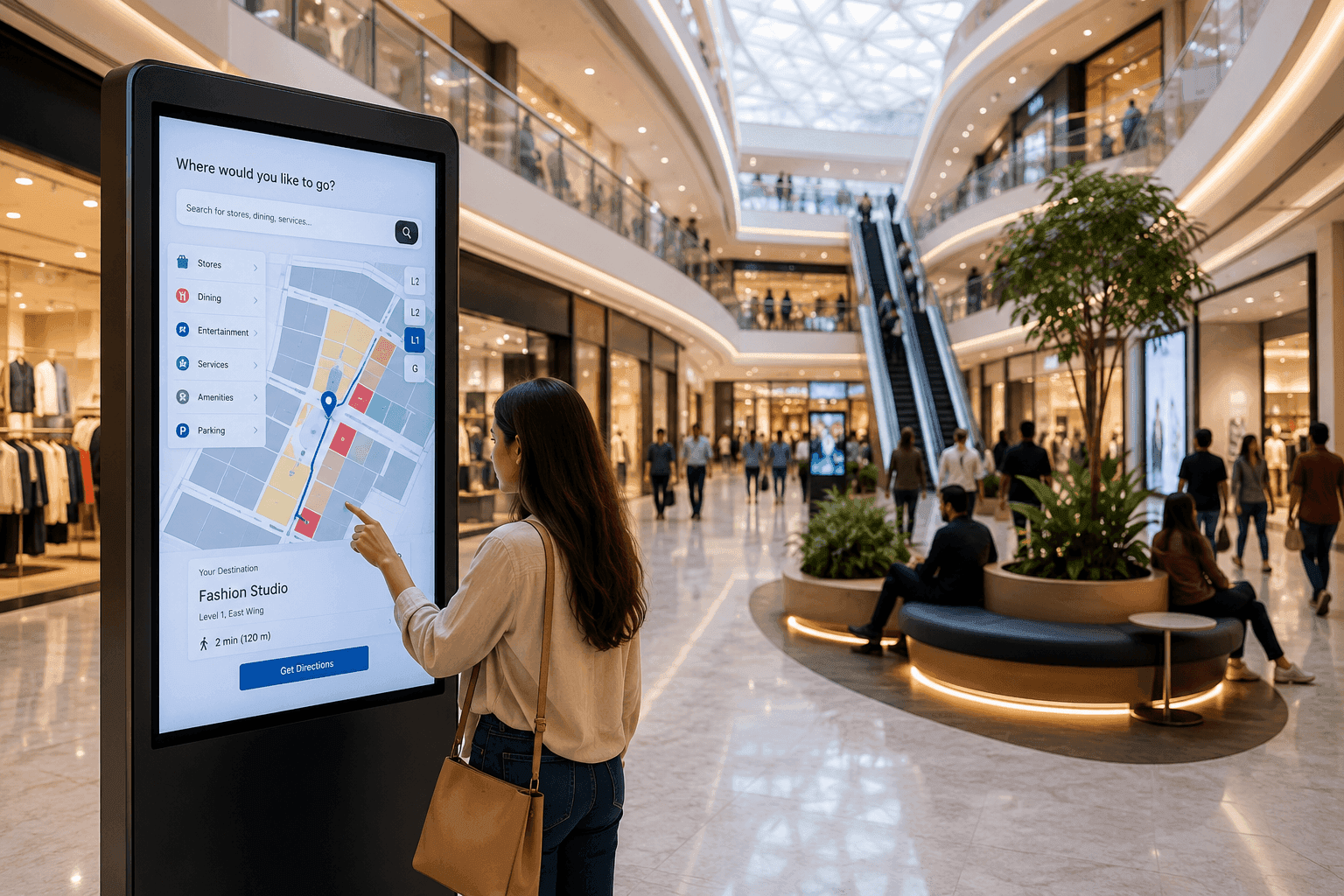
Interactive kiosks are often the most visible part of an indoor navigation system.
Placed at entrances, atriums, food courts, and major intersections, they provide visitors with immediate access to location information.
A visitor can:
- Search for a store.
- Select the destination.
- View the route.
- Transfer directions to a mobile device if supported.
- Continue navigation while walking through the mall.
Unlike static directories, kiosks create a personalized navigation experience.
For many malls, interactive kiosks also become valuable digital engagement points.
Learn more about interactive kiosk deployment strategies in our guide to interactive kiosk solutions for venues.
The Business Benefits of Indoor Navigation
Indoor navigation creates value for both visitors and mall operators.
Better Visitor Experience
Visitors spend less time feeling lost and more time enjoying the venue.
Benefits include:
- Faster destination discovery
- Reduced navigation frustration
- Easier multi-floor navigation
- Improved accessibility support
- Better experience for first-time visitors
Reduced Staff Interruptions
Many mall staff members answer the same directional questions repeatedly throughout the day.
Examples include:
- "Where is the food court?"
- "How do I get to Store X?"
- "Where is the nearest ATM?"
- "Which floor is the cinema on?"
Digital wayfinding systems can reduce dependence on manual directions by making information readily available.
Improved Tenant Visibility
One challenge for malls is ensuring every tenant receives adequate visibility.
Popular anchor stores are easy to find. Smaller tenants often struggle to attract attention.
Indoor navigation can help by:
- Making all stores searchable
- Highlighting promotions
- Supporting category-based discovery
- Featuring sponsored placements
- Improving visibility for new tenants
This creates a more balanced discovery experience across the venue.
Mobile Navigation Extends the Journey Beyond the Kiosk
Visitors increasingly expect navigation on their phones.
Modern indoor navigation platforms can extend directions from a kiosk to a mobile device through QR codes or web-based route sharing.
This creates several advantages:
- Visitors can continue navigating while walking.
- Directions remain accessible throughout the visit.
- Routes can be shared with family members.
- Visitors can discover nearby amenities along the way.
A kiosk-only approach may solve part of the navigation challenge, but mobile handoff often creates a more complete experience.
Multi-Floor Routing Matters More Than Most Operators Realize
Many malls contain:
- Multiple retail levels
- Food courts
- Entertainment zones
- Parking structures
- Office areas
- Connected towers
Without intelligent routing, visitors may struggle to understand how floors connect.
Digital wayfinding systems can guide visitors through:
- Escalators
- Elevators
- Stairways
- Accessible routes
- Building connectors
This becomes especially valuable in mixed-use developments where multiple building functions exist within a single property.
Preparing a Mall for Indoor Navigation
Successful indoor navigation projects begin with accurate venue information.
Most implementations require:
Floor Plans
Updated floor plans help create reliable navigation pathways.
Tenant Directory
A complete and current list of:
- Stores
- Restaurants
- Services
- Amenities
Brand Guidelines
Consistent visual styling helps ensure the navigation experience aligns with the mall's branding.
Update Ownership
Every venue should define who is responsible for:
- New tenant additions
- Store relocations
- Promotional updates
- Amenity changes
Keeping information current is often as important as launching the system itself.
Choosing the Right Indoor Navigation Solution
When evaluating providers, mall operators should consider more than mapping alone.
Important evaluation criteria include:
| Requirement | Why It Matters |
|---|---|
| Multi-floor routing | Supports complex visitor journeys |
| Interactive kiosks | Provides accessible on-site navigation |
| Mobile web support | Extends guidance beyond kiosks |
| Searchable destinations | Simplifies discovery |
| Analytics | Reveals visitor behavior patterns |
| Multi-language support | Improves accessibility |
| Update workflow | Keeps information accurate |
| Future scalability | Supports venue growth |
The goal is not simply digitizing a floor plan. The goal is creating a visitor experience platform that remains useful over time.
Indoor Navigation as a Visitor Experience and Revenue Layer
The most successful mall operators increasingly view indoor navigation as more than a convenience feature.
A modern wayfinding platform can support:
- Visitor guidance
- Tenant discovery
- Event promotion
- Amenity visibility
- Digital engagement
- Sponsored listings
- Operational insights
When implemented thoughtfully, indoor navigation becomes part of the overall mall experience rather than a standalone technology project.
Frequently Asked Questions
What is the difference between a digital directory and indoor navigation?
A digital directory displays location information. Indoor navigation goes further by providing route guidance from the visitor's current location to a selected destination.
Can indoor navigation work across multiple floors?
Yes. Modern wayfinding systems can support multi-floor routing using elevators, escalators, stairs, and accessibility-friendly paths.
Do visitors need to download an app?
Not necessarily. Many implementations use mobile web experiences and QR-code handoffs that work without requiring a dedicated app.
Is indoor navigation only useful for large malls?
The benefits are most noticeable in larger venues, but mid-sized malls can also improve visitor experience and tenant discovery through digital wayfinding.
Conclusion
As shopping malls become larger and more experience-focused, visitor expectations continue to rise. People expect fast, intuitive navigation that helps them find stores, amenities, dining options, and services without confusion.
Indoor navigation helps transform a complex venue into a searchable, accessible, and visitor-friendly environment. For mall operators, it supports better visitor journeys, improved tenant visibility, and a more modern digital experience.
Whether deployed through interactive kiosks, mobile navigation, or digital directories, effective wayfinding helps visitors spend less time searching and more time engaging with the venue.
Request a Venue Wayfinding Audit
If you are evaluating indoor navigation, digital directories, or interactive kiosks for a shopping mall, NavDar can help assess your venue's readiness and identify practical implementation opportunities.
Request a venue wayfinding audit or book a pilot walkthrough to explore what a modern indoor navigation experience could look like for your mall.
Venue Wayfinding
Assess your mall's readiness for digital wayfinding, interactive kiosks, and indoor navigation.
Request a Venue Wayfinding AuditNavDar Team
NavDar Team